U.S. – GHANA Executive Business Roundtable With H.E. Nana Addo Dankwa Akufo-Addo

Following the recent U.S-Ghana Business Forum in Accra, the U.S.-Africa Business Center and AmCham-Ghana are organizing, incollaboration with the Ghana Investment Promotion Center (GIPC), an Executive Business Roundtable on the margins of the United Nations General Assembly (UNGA) in September this year. The U.S.-Ghana Executive Business Roundtable will be chaired by H.E Nana Addo Dankwa Akufo-Addo, President of the Republic of Ghana and will serve as a platform to improve the commercial ties between the U.S. and Ghana.

The U.S. and Ghana enjoy a long history of cooperation. With over $1.2 billion in trade volume, the U.S is one of Ghana’s largest trading partners. The U.S.-Ghana Executive Business Roundtable will provide another opportunity for both countries to collaborate on a wide range of sectors, including energy, transport, agriculture, digital economy, industry and finance. The Executive Business Roundtable will gather captains of U.S. industries, with interest in Ghana, to foster partnerships geared towards expanding business activities, trade and investment between both countries. As H.E Nana Addo Dankwa Akufo-Addo work towards his Ghana Beyond Aid agenda through initiatives like One Distict, One Factory, opportunities abound for U.S and Ghanaian companies to work together towards achieving the President’s vision for Ghana. Through this roundtable, business leaders from both countries will explore a number of avenues to best contribute to Ghana’s path towards development and prosperity for its people.

The Roundtable will culminate into the signing of an MOU between the U.S. Chamber of Commerce and the Ghana Investment Promotion Center, which will be witnessed by H.E. Nana Addo Dankwa Akufo-Addo. Participants will also have the opportunity to engage with government officials to discuss issues of common interest and explore new business opportunities. To sustain this effort and improve the commercial relationship between the two countries, the U.S.-Africa Business Center and its partners in Ghana will develop a program of activities, including a Business Forum to be organized every year, alternating venues between Ghana and the United States.

AmCham Meeting With Deputy Assistant U.S. Trade Representative For Africa

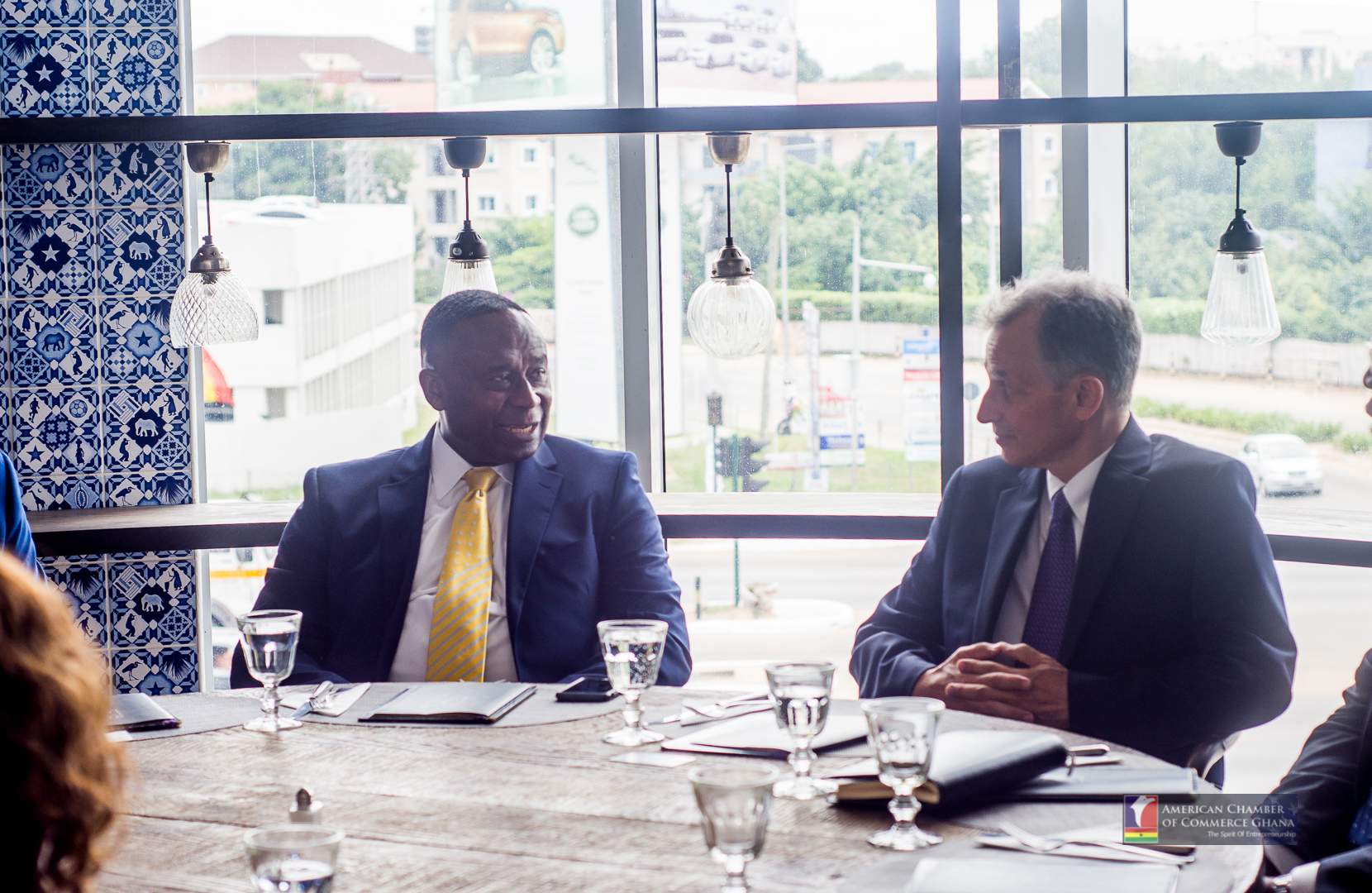
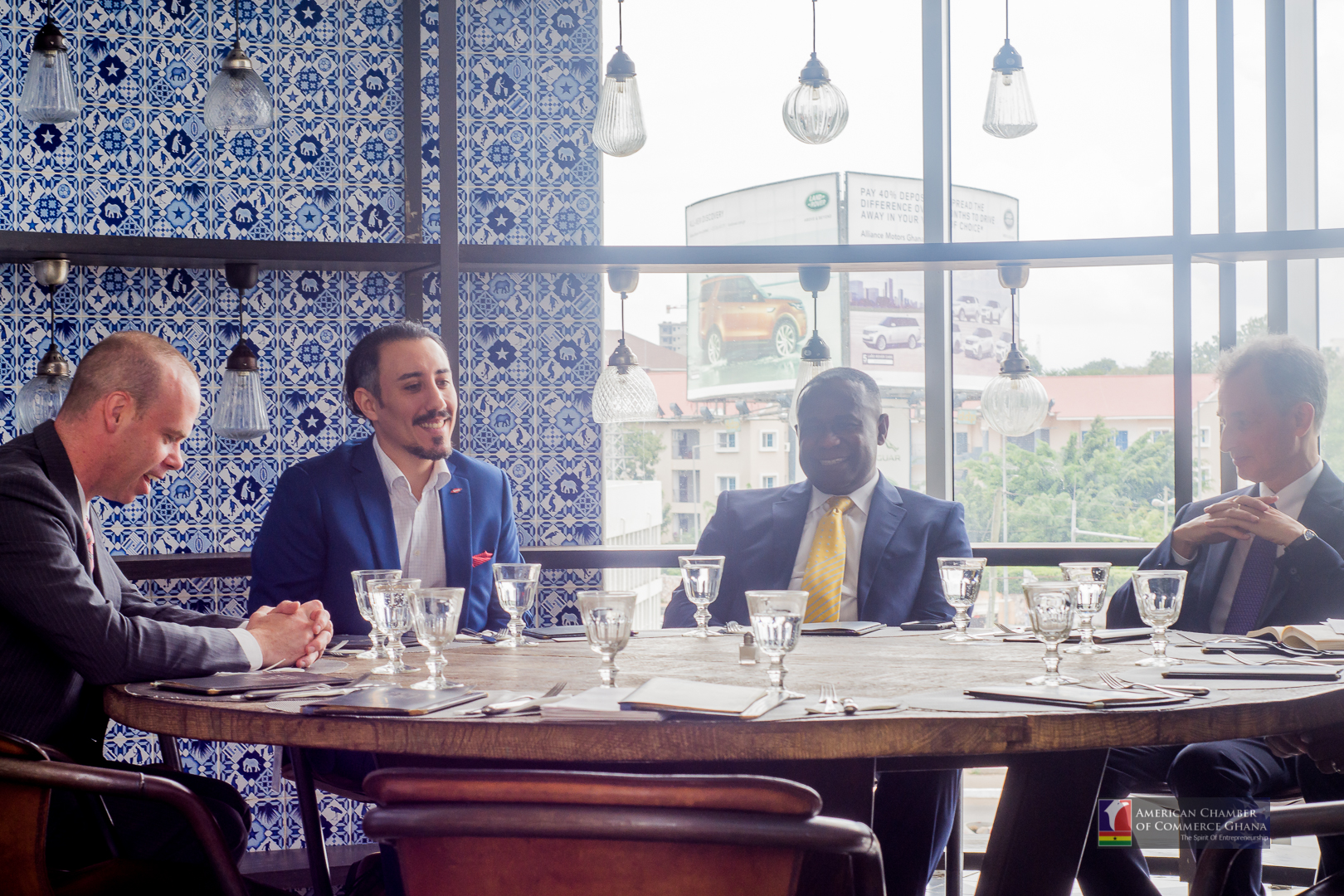
September 10, 2018. President of AmCham Ghana, Mr. Joe Mensah, Executive Secretary, Simon Madjie and some Members of the Chamber met with the Deputy Assistant, U.S. Trade Representative for Africa, Bennet Harman.

The roundtable discussion focused on how the U.S. can strengthen its trade with Ghana and the Continent with emphasis on trade facilitation, tariff and non-tariff barriers to trade. Specific challenges in the investment environment and the ease of doing business in Ghana were also discussed.

On the impact of U.S. businesses in Ghana, Mr. Joe Mensah said “the U.S. has a lot to offer Ghana and the Continent. U.S. companies have much of what African Governments say they want and need. They operate ethically, they have high quality goods and services, and they prefer to have local talents.” The U.S. should focus on deepening its relationship with Africa, he added.

The Deputy Assistant Trade Representative for Africa, Mr. Harman also reiterated the commitment of the U.S. Administration on working with Ghana, when he highlighted the July visit to Ghana by Secretary Ross and members of the PAC-DBIA. He further said that the United States Trade Representative was exploring options of creating Free Trade Agreements with certain Countries on the Continent, as a way to promote the competitive edge for U.S. Companies.

Members present at this private roundtable included representatives from Dow Chemical, Coca- Cola Bottling Company, Kosmos Energy and Cummins Ghana Limited.

The Office of the U.S. Trade Representative (USTR) is responsible for developing and coordinating U.S. international trade, commodity, and direct investment policy, and overseeing negotiations with other countries.

Ghana is currently the U.S. 81st largest goods trading partner with $1.6 billion in total (two way) goods trade during 2017. Goods exports totaled $860 million; goods imports totaled $750 million. The U.S. goods trade surplus with Ghana was $110 million in 2017.

According to the Department of Commerce, U.S. exports of goods to Ghana supported an estimated 5 thousand jobs in 2015 (latest data available).

The top U.S. export to Ghana categories (2-digit HS) in 2017 were: vehicles ($198 million), electrical machinery ($126 million), machinery ($106 million), mineral fuels ($89 million), and meat (poultry) ($53 million). The top import from Ghana categories (2-digit HS) in 2017 were: mineral fuels ($426 million), cocoa ($224 million), special other (previously exported item) ($17 million), wood and wood products ($13 million), and rubber ($12 million).

U.S. foreign direct investment (FDI) in Ghana (stock) was $1.7 billion in 2017, a 14.3% decrease from 2016. There is no information on the distribution of U.S. FDI in Ghana.

W.A.S.P Introduces Managed Print Services

W.A.S.P Limited, a Document Management Services company based in Ghana introduced Managed Print Services in Ghana. W.A.S.P is the only HP accredited Managed Print Service providers in Ghana and their approach allows you to attain tangible business benefit by adopting a strategic print management process.

MPS is an approach which analyses all of your processes and workflow of handling documents. With MPS you can outsource printing functions, whiles still retaining over quality, performance and cost. In a well managed print environment you will improve service and productivity.

MPS simplifies management and improves visibility by providing comprehensive monthly reports that include analysis of performance against service levels, consumables usage, trend in service calls, and recommendations for new or replacement equipment.

Over the past four years, W.A.S.P have successfully implemented a number of transformational projects in both the Public and Private Sectors, and the International Organisation sector.

Managing Director of W.A.S.P, Grant Webber said they firmly believe they are your partner of choice, especially given their market leadership with similar transformational projects.

Ecoalpha Introduces The Seeker Aircraft To The Ghanaian Market

Ecoalpha, a wholly owned Ghanaian aircraft dealership and aviation services provider introduced the Seeker Aircraft in Ghana at an event at the Best Western Premiere Hotel in Accra on Wednesday, August 29 2018.

The Seeker is a versatile, purpose built, light observation aircraft specially designed and developed for quality aerial surveillance. It provides unmatched surveillance specific qualities including its flexibility, maneuverability and visibility when compared to both fixed and rotary wing aircrafts.

The Seeker, a FAA Part 23 Normal Category Certified aircraft, features a side-by-side configured cockpit with helicopter-like visibility. In addition, the Seeker’s high mounted pusher propeller and convenient tail wheel landing configuration make it superior aircraft operation during short take off and landing at austere locations.

All this, coupled with the Seeker’s low operating and acquisition costs make it the most cost-effective surveillance Aircraft on the market today.

This aircraft offers great usability in various organizations and governmental agencies. In an effort to maximize its use, Ecoalpha is looking to partner with companies and governmental agencies interested in quality aerial surveillance. These include but not limited to National Security, Traffic Control, Aerial Mapping, Military Operations, Agriculture, Pipeline and Powerline Inspection, Tourism, ISR Missions, and more.

It is Ecoalpha’s vision to see at least one Seeker in every African country within the next 2 years.

Learn more about the Seeker here 

AmCham Joins Newmont Ghana At Stakeholder Engagement Forum

Newmont Ghana on August 29, 2018 held a Stakeholder Engagement Forum at the Accra Marriott Hotel to share an overview of the corporations operations and dialogue on how the corporation can employ best practices to positively impact the socio-economic lives of people in the communities they operate in.

Newmont Ghana is Ghana’s largest gold producer with a 2018 consolidated production of 435 – 465 Koz and 380 – 410 Koz at the Ahafo and Akyem mines respectively.  These mines were adjudged the best performers in Environmental Management in 2016 with Akyem mines placing first and Ahafo mines coming in second.

Senior Vice President for the Africa region, Alwyn Pretorius said the corporation is operating with a continuous improvement mindset by driving innovation through technology, streamlining production and operational processes, and strengthening business process efficiency.

The Corporation has a competitive advantage through people by providing about 1,953 full time jobs and 3,261 contract jobs. Newmont has 23% of its executive positions occupied by females and supports about 58,000 direct and indirect jobs. Their apprenticeship and learnership programmes also help develop host community talents.

By creating shared value through their operations, Newmont Ghana set up the Newmont Ahafo Development Foundation and Newmont Akyem Development Foundation which have contributed $ 25.2 million since 2007 and $7.7 million since 2013 respectively. These funds have been invested into infrastructure and social amenities projects and fund beneficiaries of scholarships.

Newmont Ghana was named the country’s Overall Largest and Best Taxpayer for 2017. The 2017 payments consisted of GHc 264 million in Corporate Income Tax, GHc138 million in Mineral Royalty, GHc 94 million in Pay As You Earn (PAYE), GHc 56 million in Withholding Tax, and GHc16 million in Forestry Levy.

Investor State Dispute Resolution within the Scope of Article 181(5) Of the 1992 Constitution of the Republic Of Ghana

By FAISAL ESENAM GBADEGBE

At a time where the World Bank has reported that Ghana’s economy is estimated to grow at a rate of 8.3 percent, which will be one of the fastest in the world, it is safe to conclude that the Republic of Ghana is the next port of call in the sub Saharan region for investors. In light of the International Law principles of legality and good faith, investments must be made bona fide within the confines of the law of the host state.

Accordingly, the Constitution of Ghana, for the purposes of protecting the public purse, clearly spells out what ought to be done by the government of Ghana when it enters into international business transactions. Most often, both the investors and government officials fail to comply with the Constitutional provision which requires that international business transactions entered into by the government of Ghana ought to be approved by the Parliament of Ghana. A failure to seek Parliamentary approval for such transactions will result in the Supreme Court of Ghana concluding that the transaction is null and void.

In a world where the protection of investments made in developing countries is of utmost concern to investing countries, the natural consequence will be for the investor to commence arbitration proceedings at neutral venue pursuant to a bilateral investment treaty or contract. In cases where the investor party is successful and secures an arbitral award against the Republic of Ghana, the emerging trend has been for the investor party to enforce such awards against Ghana outside the territorial jurisdiction of Ghana. This paper seeks to briefly highlight the principle of legality of investments and how that may adversely affect an investor’s claim against the Republic of Ghana.


Rationale and Policy of Article 181 of the 1992 Constitution of Ghana

Article 181 of the 1992 Constitution of Ghana takes its origin from article 133 of the 1969 Constitution of Ghana.  It is without doubt that the purpose of the framers of the original 1969 provision was to ensure transparency, openness by requiring parliamentary consent in relation to debt obligations contracted by the state. This original provision of the 1969 Constitution was maintained unchanged in the 1979 Constitution as Article 144. However, over the years with the influx of investors into Ghana, the need for a refinement of the provision arose. The growing need at the time, was for a legal regime which could curtail corruption by ensuring that government officials were prevented by a Constitutional measure from entering into dubious and overpriced contracts. Consistently, the framers of the 1992 Constitution expanded the scope of the long-standing provision on the giving and raising of loans, found in the previous Constitutions, to include another category, namely, ‘an international business or economic transaction to which the Government is a party.’

Under the hierarchy of the laws in the Republic of Ghana, which is unambiguously stated in article 11 of the 1992 Constitution of Ghana, the Constitution is the supreme law of Ghana. Consequently, the Ghanaian legal jurisprudence is clear that in situations where the Constitution prescribes a particular mode in which a particular act, conduct or transaction must be performed, a failure to conform to the Constitutional prescription renders that act, conduct or transaction null and void.

It is therefore not surprising that, in the case of The Attorney General v Faroe Atlantic Co. Ltd, in which the relevant matter of contention was whether a power purchase agreement (PPA) between the respondents and the Government of Ghana could be declared null and void for lack of compliance with article 181(5) of the 1992 Constitution, the Supreme Court held that compliance with the Constitutional provision was mandatory.  Due to the simple, straightforward and narrow interpretation above-mentioned given to the provision in the Faroe Atlantic case, the Supreme Court in the case of The Attorney General v. Balkan Energy Ghana Ltd and 2 others shed further light on Article 181(5).This case presented two issues to the Court for resolution.

The first was whether a Power Purchase Agreement (PPA) between the Government of Ghana and Balkan Energy (Ghana) Limited was an international business transaction within the meaning of Article 181(5). The second was whether the arbitration agreement contained in the PPA was an international business transaction within the meaning of 181(5). In dealing with the first question, the Court held that the phrase ‘international business and economic transaction to which the Government is party,’ did not only encompass agreements between entities resident abroad and the Government but it also potentially included a transaction between the Government and an entity resident in Ghana. This addressed the reality that given the complexity of contemporary international business transactions, it is assured that there will be transactions of obvious international nature which may have been concluded with the Ghana Government by entities incorporated within Ghana.  In such cases, the court was of the view that ‘the substance, rather than the form’ should prevail. Therefore, whenever it could reasonably be inferred that the transaction is international in nature the provision must apply. This could be likened to the ‘foreign control’ test used in ICSID arbitration for determining the nationality of corporate parties to a dispute.

In defining the word ‘international’, it was held that a business is considered international within the confines of Article 181(5), where the nature of the business forming the subject matter of the transaction, when it has a significant foreign element. Accordingly, the party, other than the government, to the transaction should have foreign nationality, reside in different countries, or, in the case of companies, have its place of central management and control outside Ghana. The word ‘significant’ resonates with the purpose of Article 181(5) as the framers did not have in their contemplation, subjectively or objectively, transactions of ordinary commerce. Thus, in a contract between the Government and a Ghanaian resident for the sale of cars, the fact that cars have to be imported would not be significant enough in terms of the purpose of Article 181(5), to justify characterizing such a transaction as an international business transaction. As to the meaning of ‘business’, it was held that where a transaction is commercial in nature, or pertains to, or impacts on, the wealth and resources of the country, it represents a business or economic transaction within the meaning of Article 181(5). Consistently, after setting out the above definitions the Supreme Court held that the PPA in that case was an international business transaction.

Worthy of note is the fact that, these two cases have served as the landmark cases with regards to Article 181(5) and once the interpretation given to the provision applies to a given set of facts or circumstances, the Supreme Court strictly applies the provision.

In the subsequent case of Amidu (No 1) v Attorney General, Waterville Holdings (BVI) Ltd & Woyome (No 1), the Supreme Court further held that where Article 181(5) is breached, a mere restitutionary remedy cannot be awarded, because doing so would conflict with the provisions of the Constitution. Notably, in the case of, Amidu (No 2) v Attorney General, Isofoton SA & Forson (No 1), the Supreme Court went further to hold that an international business transaction, to which the Government is party, should not cease to be treated as such under Article 181(5) simply because the activities concerned were to be financed under a loan agreement that had already been approved by Parliament.

In light of the above decisions of the Supreme Court regarding the meaning and effect of Article 181(5), it can therefore safely be proposed that with regards to the purpose and mandatory nature of the Constitutional provision, Article 181(5) of the 1992 Constitution of Ghana can be likened to the international law norm against public corruption. In this regard, it is clear that Article 181(5) of the 1992 Constitution of Ghana reflects the internationally recognized principle of proscribing corruption of public officials.


The effect of the Supreme Court interpretation of Article 181(5) of the 1992 Constitution on bilateral investment treaties.

Ghana has over the years since its independence signed twenty-eight bilateral investment treaties, with eight currently in force. The bilateral investment treaties currently in force include those signed between the Republic of Ghana and China, Switzerland, the United Kingdom, Malaysia, Germany and Denmark respectively.

Ghana in the internationalist law sense, is not a monist but a dualist state, therefore, by virtue of Article 75 of the 1992 Constitution although the President has the power to execute treaties, agreements or conventions in the name of the state, any such undertaking shall be subject to ratification by an Act of Parliament supported by votes of more than one-half of all the members of Parliament.

In the case of John Akparibo Ndebugre v Attorney General and two others (Writ No J1/5/20) the Supreme Court held that the parliamentary ratification of contracts, like treaties,  entered into by the executive is intended to ensure transparency and prevent abuse by executive power when it comes to the execution of contracts relating to the resources of Ghana.

On that account, after the needed ratification by Parliament, bilateral treaties would be deemed to be part of the laws of Ghana by virtue of Article 11(1) (b) of the 1992 Constitution. However, under the hierarchy of laws found in Article 11 of the 1992 Constitution, domesticated bilateral treaties do not supersede the 1992 Constitution of Ghana.  Consistently, the interpretation of Article 181(5) given by the Supreme Court in the cases discussed above will apply identically to bilateral treaties and in effect, any international business transaction entered into which is in the form of a contract between an investor from a contracting state and the government of Ghana will still need the necessary parliamentary approval.


Article 181(5) and the legality of Investments

The investor’s conduct in certain cases can be fundamental to a tribunal’s jurisdiction, especially with respect to allegations of serious illegality or misconduct by the investor. This is due to the reasoning that it is only just, fair and equitable that investor–state dispute resolution is unavailable with regards to investments that are inherently illegal as a matter of host State law or international public policy; or were procured only as a result of illegality or misconduct. The legality requirement therefore means that an economic transaction that might qualify factually and financially as an investment may still fall outside the jurisdiction of an international arbitral tribunal because legally it is not an investment.  According to the Fraport v Phillipines case, the primary way for legality to become a prerequisite for the exercise of jurisdiction by an ICSID tribunal is through the inclusion of an express requirement to that effect in the bilateral investment treaty.

For example, Article 1(2) of the Ghana – Malaysia BIT provides that ‘The term “investments” referred to in paragraph 1(a) shall only refer to all investments that are made in accordance with the laws, regulations and national policies of Contracting Parties.’ As a result, investments obtained illegally, fraudulently, or through any other improper means would be deemed not to constitute an investment within the scope of the treaty’s protections.

Furthermore, as noted in the Fraport v Phillipines II award, a number of tribunals have recognized the implicit legality requirement. Under this, irrespective of whether the applicable treaty contains an express legality requirement, only investments that are lawfully made can obtain the protections of an investment treaty; which includes investor-state arbitration. In SAUR v Argentina, the tribunal held that whether or not the parties to the BIT ‘mention or neglect to mention the requirement, that an investor act in accordance with host state law is not a relevant factor’. In Phoenix Action V Czech Republic, the tribunal stated that it ‘ha[d] to prevent an abuse of the system of international investments protection under the ICSID Convention, ensuring that only investments that are made in compliance with the international principle of good faith and do not attempt to abuse the system are protected’. In order for a State to raise a successful objection to jurisdiction for violations of domestic law or principles of international law the state must prove: (1) the illegal or intentionally wrongful conduct of the investor and; (2) whether the conduct is material enough to defeat jurisdiction.

The failure of international arbitral tribunals to give effect to a mandatory provision of the Constitution has the effect of undermining lofty foundational principles, such as accountability and transparency, on which the article is based.

There is also the added consideration that, estopping Ghana on such basis, will defeat international public policy as government officials may connive with investors and enter into agreements in order to bypass the necessary constitutional requirements which exist to maintain balance and are designed to ensure accountability, openness and transparency. Accordingly, a failure to comply with Article 181(5) of the 1992 Constitution of Ghana renders agreements that fall within its scope illegal and unenforceable.


Conclusion

At such a time in Ghana’s growth, when investor confidence is most needed, requisite steps should be taken by the government to ensure that the right balance is struck between the policy reason underlying Article 181(5) and the need for a conducive and an expeditious environment promoting a thriving investor environment which the country aspires to achieve.



Author’s Profile :  FAISAL ESENAM GBADEGBE

-Kwame Nkrumah University for Science and Technology, LLB ,2015

-Georgetown University, LLM International Business and Economic Law, International Arbitration and Dispute Resolution Certificate , 2018

-Associate, Chartered Institute of Arbitrators, 2018

-Barrister and Solicitor of the Supreme Court of the Republic of Ghana, 2017

A young enthusiastic lawyer with a keen interest in Transactional Law, Litigation and issues related to Investor State Dispute Resolution.

Sensitization on the New Corporate Insolvency Bill

Ghana Association of Restructuring & Insolvency Advisors (GARIA), held a two day event on 9th and 10th August, 2018 to sensitize the business community on the New Corporate Insolvency Bill. This event was held at the Accra Marriott Hotel.

Speakers at the event included Felix Addo, Anthony Oteng-Gyesi, Vicky Bright, Vish Ashiagbor and Jacob Saah. The speakers took participants through the history of the New Corporate Insolvency Bill, Ghana’s current rank on the Ease of Doing Business – Africa and World rankings and provided an overview on Insolvency and Restructuring
in Ghana.

The first legislation on insolvency in the Gold Coast was passed as the Gold Coast Bankruptcy and Insolvency Ordinance in 1857. This ordinance was replaced with new ordinances until 1962 when Professor Gower recommended the Insolvency Act, 1962 (Act 153), which was later passed.

Currently, GARIA was assigned the task of reviewing the Bodies Corporate (Official Liquidations) Act 180 and submitted its recommendations to a Committee of Experts on Company Law under the Chairmanship of Justice, Prof. Justice Date-Bah. The draft bill is presently in final drafting stage at the Attorney-General Department.

Click for more information on the New Corporate Insolvency Bill.

Exploring Probono Programs for Impact in Ghana

American Chamber of Commerce, Ghana and the Canada Ghana Chamber of Commerce hosted Pyxera Global to explore probono programs for impact in Ghana.

The meeting was to dialogue on how corporate institutions could collaborate to assist SMEs meet their business needs.

Through Global Pro Bono programs, employees provide professional services to social-mission driven clients in communities in which the employees do not live or work on a regular basis. Projects are intended to provide economic and social benefit to the local organization and community while building leadership competencies, creating market insights, and spurring innovative thinking for the participating employee.

Pyxera Global uses the unique strengths of corporations, governments, social sector organizations, educational institutions, and individuals to enhance the abilities of people and communities to solve complex problems and attain mutually beneficial goals. With a quarter century of experience in more than 90 countries, their team is passionate and dedicated to navigating challenges and pinpointing purposeful global engagement opportunities for our clients and partners.

Pyxera hopes to use this collaboration to harness corporate expertise to boost the performance of SMEs in the country.

Learn more.

Newmont Sponsored Breakfast Meeting With Visiting Governor of Nevada

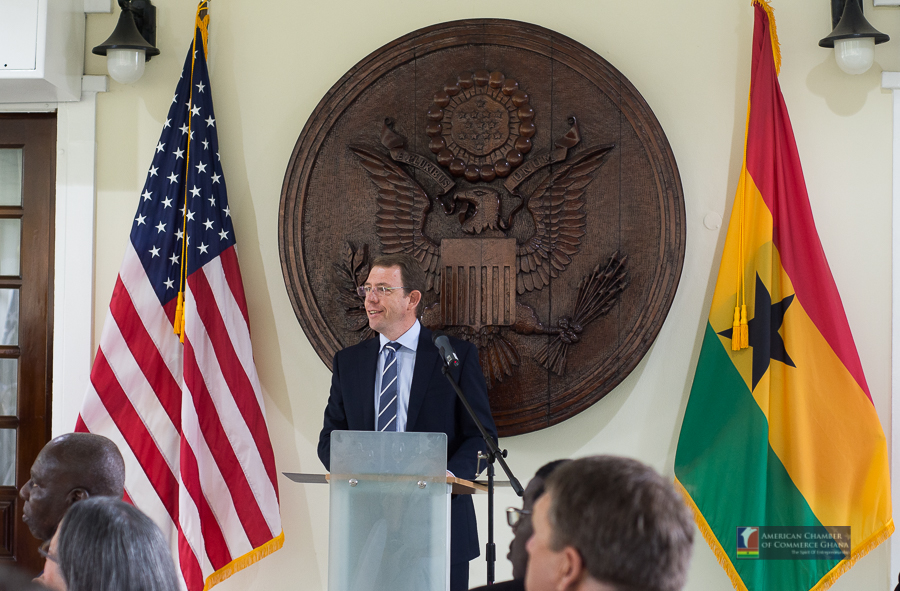
Thursday, July 26th, 2018. The American Chamber of Commerce in Ghana, Newmont Mining Corporation and the Ghana Chamber of Mines held a private breakfast meeting with the visiting Governor of Nevada, Gov. Brian Sandoval. The breakfast meeting which was hosted at the U.S. Ambassador to Ghana’s residence was to interact with the Governor and his ‘Nevada in Africa Trade Mission’ delegation.

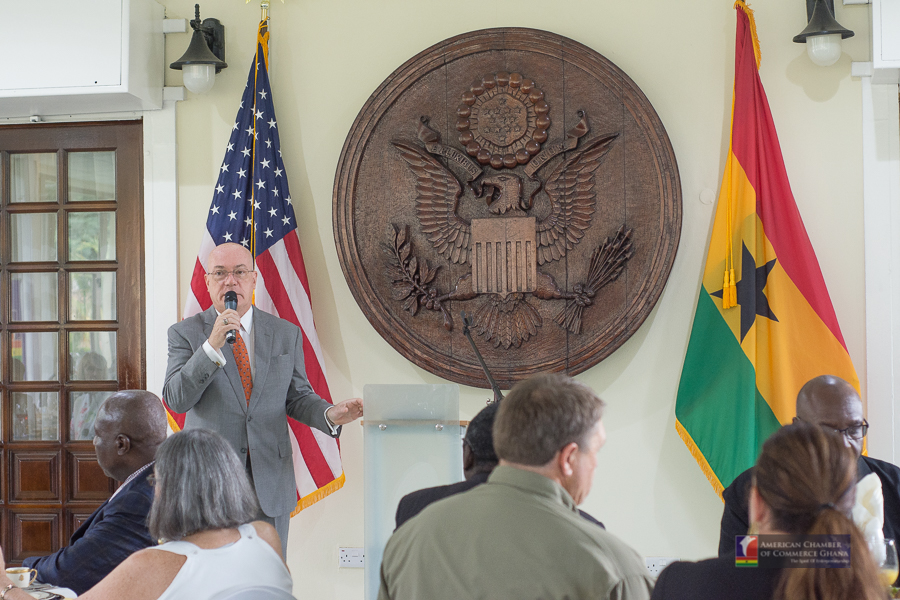
U.S. Ambassador to Ghana, Robert P.  Jackson in his opening remarks said, excellent is a constant word he uses anytime he is asked about the United States relationship with Ghana. “When people ask me about the relationship with Ghana, I characterized it in several ways, but excellent is the constant word that I use.” The ambassador said.

He took turn to share some developmental projects being undertaken in Ghana with assistance from the United States. The Ambassador mentioned the ECG Concession Agreement which seeks to introduce private sector participation to improve efficiency and service delivery. He also talked about some entrepreneurship and agricultural projects, and touched on health as well. On health, the Ambassador mentioned the construction of chief’s compounds which provides health services to people in rural areas.

“Ghana can also be proud about its democracy and it is a real star of African democracy.” Ambassador Jackson made this statement whiles commenting on Ghana’s democratic achievements. AmCham Ghana President, Mr.  Joe Mensah reiterated this during his remarks saying, it is one of the main reasons investors choose Ghana.

Mr. Joe Mensah also said the singular objective of the Chamber is to embrace the American companies coming in to do business, help them and work at creating an enabling environment for business to thrive.

He said that, the coming in of the Governor and the delegation is welcomed. “We are quite excited about it because we think, this will take the relationship to the next level as we continue to see the trade gap between the United States and Ghana narrowed.” He added.

This is Nevada’s first ever trade mission to Africa, and Governor Brian Sandoval opened his remarks by stating that history was being made. “I feel like I am standing in a moment of history because this is Nevada’s first ever trade mission to Africa, and Ghana.”
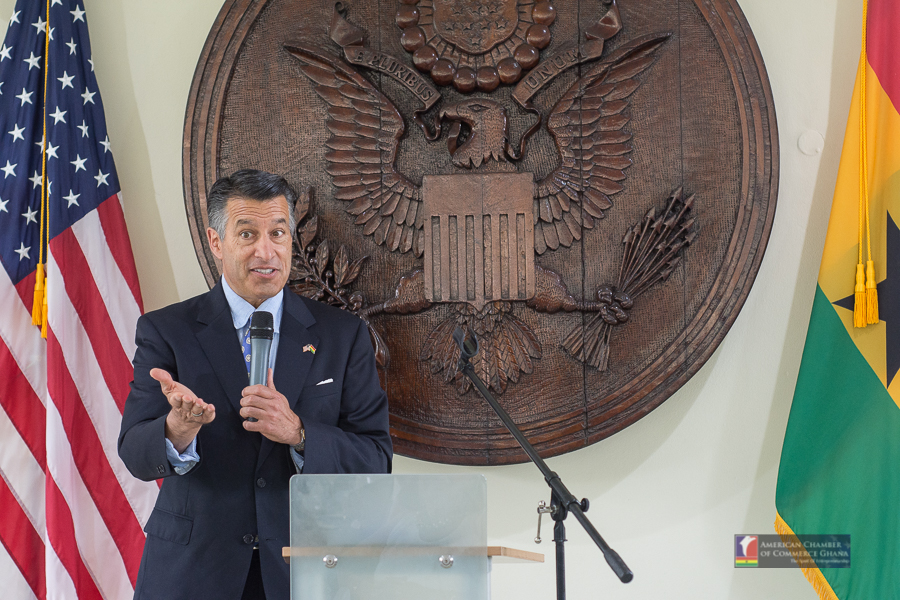
Governor Sandoval went on to say the key reasons for embarking on the trade mission is to give Nevada a global foot print and also, to diversify the State’s economy.  He said Nevada was the worst hit during the 2008 recession with unemployment hitting 14% and a $2 million dollar budget deficit.

As part of diversifying Nevada’s economy, the Governor said the State has seen the influx of companies such as Apple and Tesla, the two he said are building a huge data center and a battery factory respectively.  Top among them is Switch, a company the Governor said is building the world’s largest data center of over 5 million sq. ft. in Nevada.


These and other investments he said has helped Nevada recover from the recession with a 10% reduction in unemployment and half a billion dollar budget surplus from a 2 million dollar deficit. The governor also said the State is carrying out some infrastructure projects such us the widening of Las Vegas highway systems.

“If you move in around here, you automatically get a 10% raise because you don’t have to pay no income tax.” The Governor said the tax system in Nevada serves as a great incentive for investors.

Other speakers at the event were Alwyn Pretorius, Senior Vice President, Africa at Newmont Mining Corporation and Robert Ahomka-Lindsay, Ghana’s Deputy Minister of Trade and Industry. The two spoke on the relevance of mining to the Ghanaian economy and the readiness of the Ghanaian government to collaborate and work with developmental partners respectively.

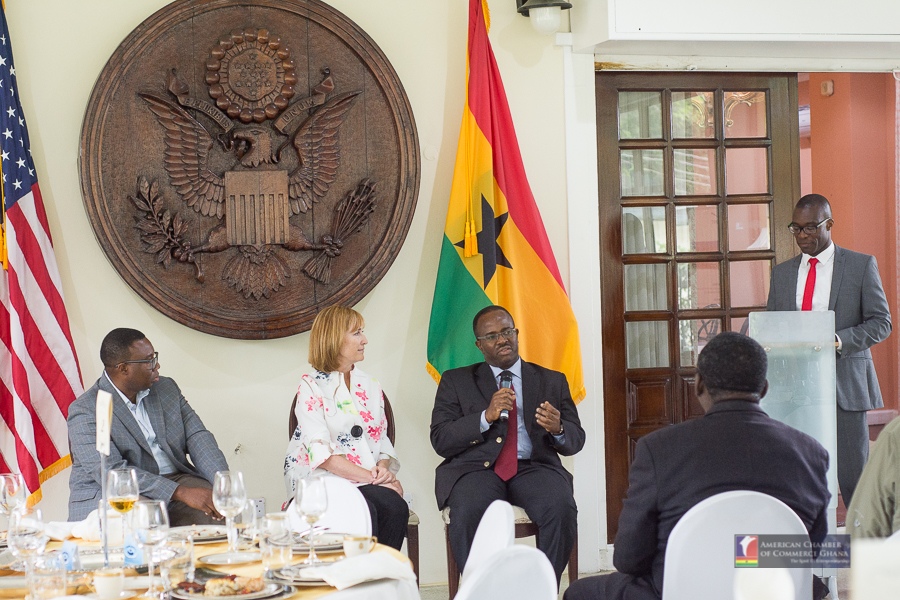
The private breakfast meeting also witnessed a panel discussion on the “State of Mining in Ghana – Challenges and Opportunities.” Panelists discussed how citizens can be best made to feel the positive impacts of mining, local content, the menace of gallamsay and responsible mining.

Also present at the event were Ghana’s Ambassador to the United States, His Excellency Dr. Barfuor Adjei-Barwuah CEO of GIPC, Yofi Grant, business executives from AmCham member companies and officials from the Ghana Chamber of Mines. The event was sponsored by Newmont Ghana.

The event gallery in below.

[unitegallery private_1]

Medtronic Africa Pty Limited Joins AmCham

The American Chamber of Commerce in Ghana is pleased to welcome Medtronic Africa Pty Limited as a new member. Medtronic Africa which has been committed to supporting the healthcare needs of the public and private sector in South Africa and Sub Saharan Africa joins AmCham  as a Gold Member.

Medtronic has a legacy of innovation and unique position as the world’s largest medical technology company which allows them to play a central role in transforming healthcare in South Africa and Sub Saharan Africa. They are also collaborating with new partners in new ways to create new innovations — ones that add both clinical and economic value. So that tomorrow, even more people can get the affordable care they need.

They have been in existence for more than 30 years and offer therapies that treat nearly 70 conditions, including some of the world’s most challenging chronic diseases — like diabetes, obesity, cancer, and heart disease. With the integration of Covidien as their Minimally Invasive Therapies Group, they can address the healthcare needs of more people around the world than ever.

The Medtronic mission is to contribute to human welfare by application of biomedical engineering in the research, design, manufacture, and sale of instruments or appliances that alleviate pain, restore health, and extend life.

AmCham Ghana welcomes you to our fold as you work to alleviate pain, restore health, and extend life in Ghana. Click here to learn more about Medtronic Africa Pty Limited.