Skip to content

Webster University IR Masterclass – African Continental Free Trade: Implementation Challenges and the Prospects for African Development

By Albert Ludwig Botchway, AmCham Communications
Albert Ludwig Botchway is the Communications Officer at the American Chamber of Commerce in Ghana (AmCham Ghana), where he leads the Chamber’s communications strategy and brand visibility. He drives stakeholder engagement, media relations, and content initiatives that strengthen U.S.–Ghana business relations. His work supports trade, investment, data protection awareness, and innovation across the Chamber’s activities

Webster University IR Masterclass – African Continental Free Trade: Implementation Challenges and the Prospects for African Development

Click to Register 

With the world being a global village, trade is an important economic factor for the development of many economies. Trading dates back to centuries where an early form of trade- barter saw the direct exchange of goods and services for other goods and services. As time evolved and globalization emerged, trade changed, becoming broader and more complex. The formation of trade blocs, such as the European Union (EU) and the Pacific Alliance, paved the way for policies such as free trade, constituting bilateral and multilateral trade, which greatly expanded market access and spurred economic growth.

According to the African Development Bank, in 2014 only 16% of international trade took place between African countries. The United Nations Conference on Trade and Development (UNCTAD) also reports that Intra-African exports were 16.6% of total exports in 2017, compared with 68.1% in Europe, 59.4% in Asia, 55.0% in America and 7.0% in Oceania.

The African Continental Free Trade Area is widely seen as a crucial driver for economic growth, industrialization, and sustainable development in Africa. The agreement seeks to create a single African market of more than a billion consumers with a combined GDP of U$2.5 trillion. Through its various protocols, the AfCFTA Agreement addresses trade in goods (tariff liberalization schedules, non-tariff barriers, rules of origin), trade in services, competition, investment, and intellectual property. It is expected to boost intra-African agricultural trade, currently estimated to be less than 20 percent of total agricultural trade.

Despite its prospects, there continue to be implementation challenges that could thwart the efforts of the agreement.
AmCham Ghana Engages with Cummins Africa and Middle East Team to Explore Industrial Growth and Partnership Opportunities

In line with our commitment to deepening engagement with key member companies and strengthening U.S.–Ghana commercial partnerships, the

AmCham Ghana Advances Private Sector Advocacy through Legal, Policy & Governance Committee

The American Chamber of Commerce, Ghana (AmCham Ghana) successfully convened the maiden meeting of its Legal, Policy &

AmCham Ghana Engages CIRIP on Corporate Recovery and Business Resilience

AmCham Ghana this week held a strategic discussion with the Corporate Insolvency and Restructuring Professionals (CIRIP), focusing on

AmCham Ghana and World Trade Center Ghana Explore Strategic Partnership

AmCham Ghana CEO Doris Afranyedey recently met with World Trade Center Ghana Managing Director Yvonne Botchey for a

AmCham Ghana Members Rally Around Key Advocacy Priorities for Health, Hospitality, Logistics, and Aviation

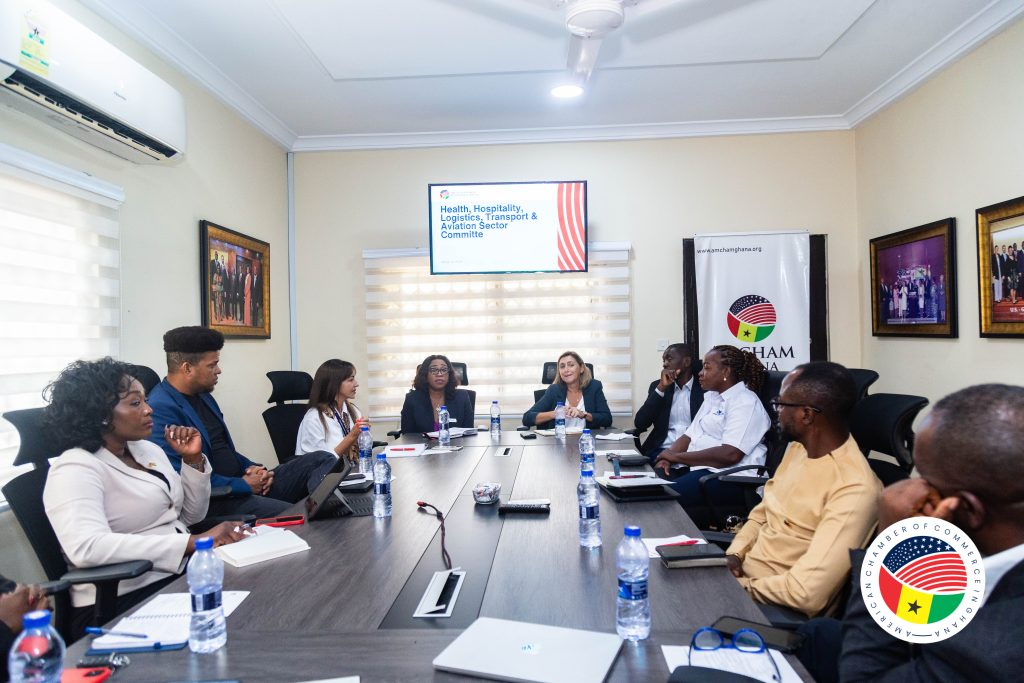
The American Chamber of Commerce in Ghana convened the inaugural sitting of its Health, Hospitality, Logistics, and Aviation

AmCham Ghana Financial Services & Professional Advisory Sector Committee Maiden Meeting

Accra, Ghana – Tuesday, 3rd March 2026 – The American Chamber of Commerce in Ghana (AmCham Ghana), led