Newmont Sponsored Breakfast Meeting With Visiting Governor of Nevada

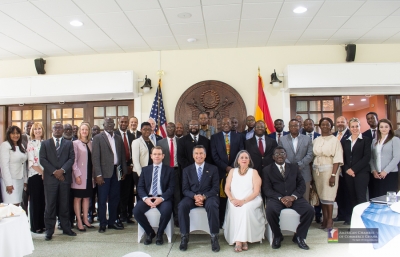
Thursday, July 26th, 2018. The American Chamber of Commerce in Ghana, Newmont Mining Corporation and the Ghana Chamber of Mines held a private breakfast meeting with the visiting Governor of Nevada, Gov. Brian Sandoval. The breakfast meeting which was hosted at the U.S. Ambassador to Ghana’s residence was to interact with the Governor and his ‘Nevada in Africa Trade Mission’ delegation.

U.S. Ambassador to Ghana, Robert P.  Jackson in his opening remarks said, excellent is a constant word he uses anytime he is asked about the United States relationship with Ghana. “When people ask me about the relationship with Ghana, I characterized it in several ways, but excellent is the constant word that I use.” The ambassador said.

He took turn to share some developmental projects being undertaken in Ghana with assistance from the United States. The Ambassador mentioned the ECG Concession Agreement which seeks to introduce private sector participation to improve efficiency and service delivery. He also talked about some entrepreneurship and agricultural projects, and touched on health as well. On health, the Ambassador mentioned the construction of chief’s compounds which provides health services to people in rural areas.

“Ghana can also be proud about its democracy and it is a real star of African democracy.” Ambassador Jackson made this statement whiles commenting on Ghana’s democratic achievements. AmCham Ghana President, Mr.  Joe Mensah reiterated this during his remarks saying, it is one of the main reasons investors choose Ghana.

Mr. Joe Mensah also said the singular objective of the Chamber is to embrace the American companies coming in to do business, help them and work at creating an enabling environment for business to thrive.

He said that, the coming in of the Governor and the delegation is welcomed. “We are quite excited about it because we think, this will take the relationship to the next level as we continue to see the trade gap between the United States and Ghana narrowed.” He added.

This is Nevada’s first ever trade mission to Africa, and Governor Brian Sandoval opened his remarks by stating that history was being made. “I feel like I am standing in a moment of history because this is Nevada’s first ever trade mission to Africa, and Ghana.”

Governor Sandoval went on to say the key reasons for embarking on the trade mission is to give Nevada a global foot print and also, to diversify the State’s economy.  He said Nevada was the worst hit during the 2008 recession with unemployment hitting 14% and a $2 million dollar budget deficit.

As part of diversifying Nevada’s economy, the Governor said the State has seen the influx of companies such as Apple and Tesla, the two he said are building a huge data center and a battery factory respectively.  Top among them is Switch, a company the Governor said is building the world’s largest data center of over 5 million sq. ft. in Nevada.


These and other investments he said has helped Nevada recover from the recession with a 10% reduction in unemployment and half a billion dollar budget surplus from a 2 million dollar deficit. The governor also said the State is carrying out some infrastructure projects such us the widening of Las Vegas highway systems.

“If you move in around here, you automatically get a 10% raise because you don’t have to pay no income tax.” The Governor said the tax system in Nevada serves as a great incentive for investors.

Other speakers at the event were Alwyn Pretorius, Senior Vice President, Africa at Newmont Mining Corporation and Robert Ahomka-Lindsay, Ghana’s Deputy Minister of Trade and Industry. The two spoke on the relevance of mining to the Ghanaian economy and the readiness of the Ghanaian government to collaborate and work with developmental partners respectively.

The private breakfast meeting also witnessed a panel discussion on the “State of Mining in Ghana – Challenges and Opportunities.” Panelists discussed how citizens can be best made to feel the positive impacts of mining, local content, the menace of gallamsay and responsible mining.

Also present at the event were Ghana’s Ambassador to the United States, His Excellency Dr. Barfuor Adjei-Barwuah CEO of GIPC, Yofi Grant, business executives from AmCham member companies and officials from the Ghana Chamber of Mines. The event was sponsored by Newmont Ghana.

The event gallery in below.

[unitegallery private_1]

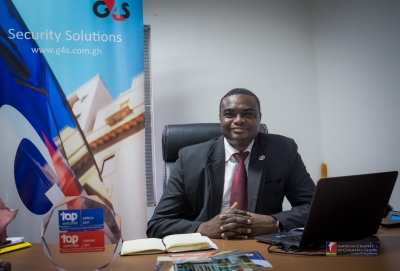
G4S | A Leading Integrated Security Solutions Company in Ghana

In this edition, we put the spotlight on G4S Ghana. G4S Security Services Ghana Limited is the leading integrated security solutions company in Ghana. The company has world-class expertise in the areas of protective security, manned guarding, secure mobility services, executive alarm monitoring and response, vehicle tracking, risk consultancy and security surveys.

G4S provides flexible and effective integrated security plans and solutions centred on their clients’ needs. This flexibility is mirrored in commercial proposals that provide cost effective solutions based on economies of scale derived from accurate pre-planning and efficient resource management.

They specialise in outsourced business processes and facilities in sectors where security and safety risks are considered a strategic threat. They use their global expertise and local knowledge in the assessment and management of security and safety risks for buildings, infrastructure, materials, valuables, people and society.

G4S develop long-term strategic partnerships with customers in key sectors where they can help them to deliver their own business objectives through either increasing their revenues, reducing costs, managing risks, protecting critical assets or improving their service delivery to the customers they serve. They do this by understanding the environments in which their customers operate, the pressures they face and the things that matter to them most.

G4S Ghana employs over six thousand people and has been awarded Top Employer status for the 2nd year running.

Micheal Concar, Director of Sale and Marketing at G4S shared with us company principles that has made them number one in the industry.

G4S Plc has G4S Security Services Limited as its main operating company in Ghana.   Contact information is listed below for the Head office based in Accra.

G4S Security Services (Ghana) Limited
31 Second Labone Street
Labone
Accra
GHANA
West Africa

Tel:

(+233) 0302 779570

(+233) 0244 313871

(+233) 0544 123447

administration@gh.g4s.com

Accra Marriott Hotel | Leading Global Lodging Company Joins AmCham

A leader in the global lodging industry, Marriott International, Inc. which opened recently in Accra as Accra Marriott Hotel has joined the American Chamber of Commerce in Ghana.

The company has more than 6,500 properties across 127 countries and territories, and the Accra facility which located opposite Kotoka International Airport has 208 well-appointed rooms, 3 enticing dining venues, 800 sqm of meeting space, a pool and fully equipped fitness center. Accra Marriott Hotel is the number one premium business hotel in the Airport City and the wider Accra Area.

The hotel is equipped with facilities to enable you host a special occasion in their 17,000 square feet flexible event space. Their largest venue, the Nkrumah Ballroom, can accommodate up to 650 guests. Accra Marriott Hotel elevates your stay with complimentary breakfast and a free and fast Wi-Fi connection in all guest rooms.

Accra Marriott Guest rooms range from Deluxe Guest room which has 1 King size bed or 2 double size beds. Club rooms comes with Concierge lounge access and a Guest room with 1 King size bed or 2 double size beds. The Junior suite of the hotel comes with a King size bed and a Sofa bed, with the ultimate, the Presidential suite which comes with 1 Bedroom Suite with a King size bed and a Sofa bed. 

Their restaurant features a wide range of tasty local and international  meals with a Bar-B-Q and picnic area. Accra Marriott provides state-of-the-art business facilities and innovative spaces such as The Greatroom, which allows guests to seamlessly blend work and play. The hotel provides sophisticated spaces and experiences that keep the mind balanced, sharp and inspired, making it the ideal “Gateway to West Africa” whether on business or on leisure.

We welcome Accra Marriott to the chamber of commerce in Ghana and urge you to take advantage of the hotel’s prime location in the heart of Airport City and in close proximity to Accra’s buzzing city centre. Learn more about Marriott Accra Hotel.

Medtronic Africa Pty Limited Joins AmCham

The American Chamber of Commerce in Ghana is pleased to welcome Medtronic Africa Pty Limited as a new member. Medtronic Africa which has been committed to supporting the healthcare needs of the public and private sector in South Africa and Sub Saharan Africa joins AmCham  as a Gold Member.

Medtronic has a legacy of innovation and unique position as the world’s largest medical technology company which allows them to play a central role in transforming healthcare in South Africa and Sub Saharan Africa. They are also collaborating with new partners in new ways to create new innovations — ones that add both clinical and economic value. So that tomorrow, even more people can get the affordable care they need.

They have been in existence for more than 30 years and offer therapies that treat nearly 70 conditions, including some of the world’s most challenging chronic diseases — like diabetes, obesity, cancer, and heart disease. With the integration of Covidien as their Minimally Invasive Therapies Group, they can address the healthcare needs of more people around the world than ever.

The Medtronic mission is to contribute to human welfare by application of biomedical engineering in the research, design, manufacture, and sale of instruments or appliances that alleviate pain, restore health, and extend life.

AmCham Ghana welcomes you to our fold as you work to alleviate pain, restore health, and extend life in Ghana. Click here to learn more about Medtronic Africa Pty Limited.

Platinum Member : Johnson & Johnson Medical Joins AmCham

The Johnson & Johnson Medical Companies which offers the world’s largest range of consumer healthcare products joins AmCham Ghana as platinum members. Their baby care, skin care, oral care, wound care, over-the-counter and women’s health products feature brands trusted by consumers and healthcare professionals worldwide.

Having made significant contributions to surgery for more than a century, the Johnson & Johnson Medical Devices Companies are in the business of reaching more patients and restoring more lives. The group represents the most comprehensive surgical technology and specialty solutions business in the world, offering an unparalleled breadth of products, services, programs and research and development capabilities directed at advancing patient care while delivering clinical and economic value to health care systems worldwide.

From the Office of the Chief Medical Officer (OCMO), their approach is reinforced by a cutting-edge single medical safety standard to which all of their products are held. The OCMO takes an evidence- and science-based, ethics- and values-driven approach to medical safety—with an emphasis on transparency.

The Johnson & Johnson Company in 2017 opened a new office in Ghana. The newly established West Africa Regional Operations in collaboration with local health delivery partners will tackle emerging health priorities in West Africa.

Priscilla Owusu-Sekyere, Country Manager of the Johnson & Johnson office in Accra hinted the office will help improve the quality and access to health care in West Africa.

Johnson & Johnson’s office in Ghana will help coordinate the company’s global public health capabilities and resources to deliver a sustainable, measurable impact against significant public health needs in the region. The team in Ghana will translate the company’s strategy into locally-executable programs that drive health impact in collaboration with local health delivery partners. Business development teams from Johnson & Johnson companies will also collaborate with academic centers and entrepreneurs to explore local innovative healthcare-based initiatives. Learn more

AmCham Ghana is pleased to have the Johnson & Johnson Medical Companies in its fold as they work to provide the best of healthcare for the people of Ghana and West Africa.

Accra Marriott Hotel Opens in the Heart of Airport City

The leading global lodging company with more than 6,500 properties across 127 countries and territories, Marriott International, Inc. has opened in Ghana as Accra Marriott Hotel.

Opposite Kotoka International Airport, Accra Marriott Hotel is located in the heart of Airport City, a burgeoning urban development within the capital, 7.5km outside of Accra’s city center, within easy access from major corporate businesses and government entities. With 208 well-appointed rooms, 3 enticing dining venues, 800 sqm of meeting space, a pool and fully equipped fitness center, Accra Marriott Hotel is the number one premium business hotel in the Airport City and the wider Accra Area.

The hotel is equipped with facilities to enable you host a special occasion in their 17,000 square feet flexible event space. Their largest venue, the Nkrumah Ballroom, can accommodate up to 650 guests. Accra Marriott Hotel elevates your stay with complimentary breakfast and a free and fast Wi-Fi connection in all guest rooms.

Accra Marriott Guest rooms range from Deluxe Guest room which has 1 King size bed or 2 double size beds. Club rooms comes with Concierge lounge access and a Guest room with 1 King size bed or 2 double size beds. The Junior suite of the hotel comes with a King size bed and a Sofa bed, with the ultimate, the Presidential suite which comes with 1 Bedroom Suite with a King size bed and a Sofa bed. 

Their restaurant features a wide range of tasty local and international  meals with a Bar-B-Q and picnic area. Accra Marriott provides state-of-the-art business facilities and innovative spaces such as The Greatroom, which allows guests to seamlessly blend work and play. The hotel provides sophisticated spaces and experiences that keep the mind balanced, sharp and inspired, making it the ideal “Gateway to West Africa” whether on business or on leisure.

AmCham Ghana Executive Secretary, Simon Madjie visited Accra Marriott prior to its official opening.

Take advantage of the hotel’s prime location in the heart of Airport City and in close proximity to Accra’s buzzing city centre. Learn more about Marriott Accra Hotel.

The Conship Story

Consolidated shipping agencies Limited (Conship),provides quality services across all spheres of the logistics industry, commenced operations in 1996 as a limited liability company, primarily focusing on Ocean freight forwarding.

Over the years, Conship diversified its operations into other areas of the logistics Industry, such as Airfreight, Marine and Husbandry, Logistics and Projects. The discovery of oil in commercial quantities in the Western Region (Offshore) of Ghana brought with it enormous opportunities for the Logistics and Supply Chain Industry. In this regard, Conship is currently recognized as an offshore and onshore logistics services company.

Conship is strategically headquartered on the 5th Floor of the Silver Star towers.. This location of the headquarters enhances operational activities resulting in swift delivery which enable us to meet their clients KPI’s.

The company has three other operational branches strategically located in Tema, Accra and Takoradi.

Executive Secretary of the AmCham Ghana, Simon Madjie had a conversation with Dr. M. C. Vasnani, CEO of Conship. He shared a brief history on how the company started, their strategic partnerships and the principles that have brought the company this far. They also talked about the upcoming  Offshore Technology Conference (OTC) in Houston, Texas, USA.  Watch the video below.

Conship’s services range from Freight Forwarding, Projects, Oil & Gas Services and Ship Agency. Aside being a giant in the provision of services in the Oil and Gas industry, Conship has strong strengths in all areas of logistics including the vertical markets which include Telecommunication, Consumables, and Contract Logistics amongst others.

As a Certified Member of the Anti-Bribery and Corruption global institute TRACE, Conship has set the pace and the standards in Ghana and this has placed Conship above all others. Click to learn more and contact Conship. 

Rendeavour Building Africa’s Largest Urban Landscape

Appolonia City is a project of Rendeavour, Africa’s largest urban land developer with over 30,000 acres of visionary projects in the growth trajectories of large cities in Kenya, Ghana, Nigeria, Zambia and Democratic Republic of Congo.

Appolonia City is a unique partnership between Rendeavour, Africa’s largest urban land developer, and the Chiefs, leaders and residents of the Appolonia community.

The development was conceived and launched in Accra in 2012. Following the completion of initial infrastructure in 2015, Appolonia City’s first residential phase was introduced to the market.

CEO of Appolonia City, Bright Owusu Amofah

Rendeavour’s vision goes beyond alleviating what is a self-evident problem – that of stifling urban congestion and a dearth of quality housing and commercial property in Africa. Rather, they aim to help create the infrastructure – the living and working spaces, communities, schools and hospitals – that will help sustain and accelerate Africa’s economic growth, meet the aspirations of Africa’s burgeoning middle classes, and serve as a catalyst for further urban development.

Appolonia City is a mixed-use and mixed-income urban development that will be home to 88,000 residents and tens of thousands of daily visitors.

AmCham Ghana Exec. Secretary, Simon Madjie (left) presenting AmCham Membership Certificate to CEO of Appolonia City, Bright Owusu Amofah.

The 2,325-acre project encompasses residential, commercial, retail and light industrial developments, as well as social amenities like schools, healthcare and family parks.

Appolonia City offers you all you need in one place. A place to live, work, shop, a place for entertainment, relaxation and much more – in a well-planned natural environment coupled with the highest standards of infrastructure.

 click here for more info.

AmCham Visits MAC Ghana

MAC Ghana is a 100% owned company of Mansour International FZCO and the exclusive distributor for Chevrolet & Isuzu range of products (Passenger cars, Pickups, Trucks, Buses) in Ghana since 2014.

Mansour Group is a multinational conglomerate founded in Egypt, with operations across the globe. The company is the second largest company in Egypt by revenue. It is also the largest General Motors dealer in the world, and the fifth largest distributor of Caterpillar Inc. products globally. It also has contracts in Egypt to represent a range of international brands, including McDonald’s, Chevrolet, Red Bull, UPS and Imperial Brands.

MAC Ghana started its operations in Accra, Ghana in August, 2014 with their first 3S facility on the Spintex road in Accra. In a short span since the inception, MAC Ghana made a remarkable presence in Ghana and have successfully sold over 1000 vehicles. In this same period, they have laid down the foundation for building a strong brand equity for both Chevrolet & Isuzu through investment in world class facilities, people and processes.

As part of the groups ongoing strategy for Ghana and towards the long term commitment, MAC Ghana recently opened another world class 3S facility in Kumasi and with future plans to grow the business through expansion of retail facilities in all major towns across the landscape of Ghana.

MAC Ghana are recipients of “Ghana Automotive Awards”  – “Most Promising Auto Company of the Year” in 2015  and “Best Service Dealer” in 2016.

Regulating Ghana’s International Trade | The Role Of The Ghana International Trade Commission

By Simon Madjie, Executive Secretary, American Chamber of Commerce in Ghana and  Dode Seidu, International Trade Consultant & Founder of Frontier Market Advisors.

Introduction

This article provides a preview of Ghana’s attempt at regulating its international trading environment through the establishment of the Ghana International Trade Commission.

International trade, though largely an economic activity, is governed by rules. The World Trade Organization (WTO) provides the forum for a multilateral rule-based global trading system that ensures that the trading system is fair. Yet not all international trade is rule-based-some countries support their domestic industries to produce and be competitive in international markets. Support provided through subsidies may make the exported products cheaper, however, such products hurt domestic industries producing similar products. Within the framework of the WTO countries have the policy and legal space to protect their domestic industries from unfair trade practices. However determining whether, a country’s domestic industries are being hurt by other countries imports into that country is not an easy task.

In many countries, organizations have been established with the view to provide impartial investigations, adjudication and imposition of measures to protect domestic industries from the harmful effects of international trade.

The United States of America has the U.S International Trade Commission (USITC) set up in September 1916, which is an independent, bipartisan, quasi-judicial federal agency that determines the impact of imports on U.S industries and directs action against unfair trade practices such as subsidies, dumping, and infringement of patent, trademark and copyright.

The Canadian International Trade Tribunal (CITT) provides Canadian and International businesses with access to fair, transparent and timely processes for the investigation of trade remedy cases and complaints concerning federal government procurement and for the adjudication of appeals on customs and excise matters. At the request of the Canadian Government, the Trade Tribunal provides advice on tariff, trade, commercial and economic matters.

Similarly, the International Trade Commission of South Africa (ITAC) established in 2003, but existed in many different forms since 1924, has the mandate to foster economic growth within South Africa and the Common Customs Union Area for Southern African countries by establishing an efficient and effective system for the administration of international trade through customs tariff investigations, trade remedies, import and export controls.

Ghana’s Industrial Sector

The industrial sector in Ghana is described to comprise: manufacturing, construction, mining and quarrying, electricity, water and sewage sub-sectors. In manufacturing, you have firms that are involved in the food processing, beverages, tobacco, textiles, petroleum refinery, cement production etc. Within the construction sub-sector, major activities include the construction, repair, demolition of buildings, highways, sewers, bridges, streets, roads, railways and communications systems. Within the mining and quarrying sub-sector are activities that involve the extraction of gold, diamond, bauxite, salt, stones and sand. Electricity, water and sewage sub-sector involves the production and distribution of electricity and water.

Post Ghana’s independence, successive governments have focused on the transformation of the country’s industrial base. Governments have implemented a number of policies including import substitution industrialization drives to an over-liberalized economy.

However, Ghana’s industrial sector has significantly reduced its contribution to the country’s Gross Domestic Product over the years. From an average of 25% contribution to GDP from 1996-2000, the sector reduced to less than 20% in 2012 and thereafter. Currently, the industrial sector is largely driven by the Mining and Petroleum subsectors and manufacturing is at an all-time low.

Besides issues of cost of credit, relatively high cost and unreliable electricity supply to the manufacturing sector, one of the major reasons cited for the collapse of the manufacturing sector has been Ghana’s over liberalization policies since the mid-1980’s which opened the country’s market to large volumes of imported goods.

Ghana’s manufacturing sector, very nascent has suffered severely from fair and unfair competition from imports.

Unfair Trade Practices Affecting Ghana’s Industry

Unfair trade practices is a term that can be used to describe all forms of international trade relations that contravenes the principle of non-discrimination. The principle of non-discrimination comprises two key principles: most-favoured nation and national treatment. The most-favour nation principle in international trade indicates that whatever favours a country offers to a trading partner/country, that favour must be available to other trading partners/countries. The national treatment principle does not permit countries to treat goods originating from that country better than imports. These principles notwithstanding, countries, companies and traders often make and are involved in trade related rules that negatively affect trade.

Ghanaian firms have indicated a number of unfair trade practices that have affected their ability to compete domestically and internationally. Ghanaian firms cite dumping-a situation where the price of a good is lower in the foreign market, than it is in the country of manufacture. Another often cited unfair practice is intellectual property infringements-such as piracy, abuse of trademarks and counterfeiting. Also, there has been instances where manufacturers have claimed that importers of similar goods they manufacture declare and pay lesser imports tariffs thereby undercutting prices on the market in the domestic market.

Unfair trade practices do not only refer to imports, it also includes unfair competition on the domestic market, where companies collude, connive and involve themselves in anti-competitive practices to gain market share and market dominance.

Whereas these complaints have been made by the private sector, the biggest challenges have been the lack of legal and regulatory regime receive complaints, investigate and adjudicate where the trading public think they are experiencing unfair trade.  Until independently investigated, many of these claims will remain allegations.

The Ghana International Trade Commission will provide the legal space to receive petitions, undertake independent investigations and adjudicate on unfair trade practices that affect the domestic industry.

Ghana International Trade Commission (GITC)

The Ghana International Trade Commission was established by an Act of Parliament in September 2016 to regulate Ghana’s international trade architecture in conformity with the rules and regulations of the World Trade Organization (WTO) and other International Trading Systems and Rules. Prior to the GITC’s establishment, the Tariff Advisory Board an administrative body under the Ministry of Trade and Industry, provided investigative and policy advice to the Ministry in respect of tariff adjustment and safeguard measures. The transition from the Tariff Advisory Board to Ghana International Trade Commission has taken many years.

Objectives and Functions of the Commission

According to the GITC Act, the objectives of the Commission include ensuring fair competition for persons engaged in domestic production and international trade; overseeing Ghana’s compliance with international trade rules and regulations; protecting the domestic industry or market from the impact of unfair trade practices and ensuring transparency, fairness, efficiency and objectivity in the application of measures affecting international trade and the use of world trade measures.


Some of the notable functions of the Commission shall include the following:

  1. Advise, recommend and provide analytical support to the Minister of Trade & Industry on: proposals for trade-related legislation; preparation of documentation and negotiating position of Government during international trade negotiations; Ghana’s compliance with its bilateral and multilateral trade treaties and obligations; tariff levels for specific sectors of the economy and on matters affecting trade and industry after monitoring and reviewing the Country’s international trade.
  2. For Manufacturers, the Commission will determine complaints before it in areas of Safeguard Measures; Subsidisation of Imported Products by Foreign Governments; the Dumping of imported products into our domestic market; tariff adjustments and actions which are deemed to affect fair trade.
  • For Importers and Traders, the Commission will settle disputes arising from classification and valuation of imported products between them and the Customs Division of the Ghana Revenue Authority.
  1. For Exporters, the Commission will conduct studies and publish reports on the competitiveness of Ghana’s tariff structure and its impact on the domestic industry, market access opportunities and challenges with exports from Ghana.

Ghana International Trade Commission

In Ghana activities towards the setting up of the International Trade Commission commenced with the inauguration of the Tariff Advisory Board under the auspices of the Ministry of Trade & Industry in September 2009. The Parliament of Ghana passed the Ghana International Trade Commission Act which was accented to by the President on September 14, 2016 and gazetted on September 22, 2016, however processes towards the operationalization of the GITC has been unduly slow.

Industry players have on numerous occasions called on Government as a matter of urgency to announce the commissioners and inaugurate the Board, one such strong advocate has been Dr. Dawson Amoah of Ghacem and the Association of Ghana Industries who was quoted in a Daily Graphic publication on June 26, 2017 as saying “justice delayed is justice denied.” To wit ‘delay in the implementation of GITC meant delayed justice for local manufacturers. In a publication on March 26,  this year, the Managing Director of Aluworks- a local aluminium manufacturing company reiterated the urgent need for the operationalization of the GITC when he said “Ghana is currently in a position where a lot of unfair trade is upon our doorsteps to the detriment of local industry and local trade, and it has decimated our manufacturing sector and need urgent redress…We now await the inauguration of the Commission so that it will be able to begin work towards righting the wrongs that have been foisted on Ghana industry for so long, and it has indeed reduced some sections of industry to close extinction”

The President, H.E Nana Addo Dankwa Akufo-Addo at the Ghana Expatiate Awards announced that the Government has appointed a five Member governing board of the GITC. This announcement by the Government sets into motion activities to operationalize the Commission. Industry watchers are waiting keenly for the official swearing in of the Commissioners.  It is anticipated that the establishment and effective functioning of the GITC will accrue some form of protection for local industries, generatee revenue for Government through levies and duties and it will ultimately promote and attract foreign direct investment, especially into the manufacturing sector.

Governing and Composition of GITC Board

The GITC Act indicate, that the Commission is governed by a five member board-all appointed by the President. The chairperson must be a retired Justice of the Superior Court of Judicature or a person qualified to be appointed as such and at least one Member of the Board must be a woman. Board Members of the GITC are expected to have expertise in economics, accounting, international marketing, distribution of goods and services, international trade law or be persons with experience in industry. The GITC will also have a secretariat, headed by an Executive Secretary, appointed by the President to administer the day-to-day activities of the commission. The Commission is expected to be well resourced in terms of the number and quality of required staff and resources-both financial and logistical.


Activities of the Commission

The GITC will have investigative and adjudicative function-just like the USITC.


  1. Investigations: Investigations by the Commission may be initiated by a corporate or individual petitioner or on the Commission’s own initiative.The Commission is expected to conduct its proceedings in public and in private by request of the parties. Proceedings are to be conducted expeditiously and at the conclusion of hearings, record its decision in writing providing reasons for that decision. The Commission may also make an application to the High Court to compel a person to comply with its decision, order or ruling.


  1. Adjudicative: the GITC can impose trade remedies-through the Minister of Trade and Industry, if it believes that there is a material injury to Ghana’s domestic industry. The GITC may impose:
    1. Safeguard Measures: these are measures imposed when increasing imports materially affect domestic producers. The Commission will consider the rate and amount of the increase in imported products absolute and relative terms; the share of the domestic market ceded to imported products and changes in the levels of sales, production, productivity, capacity utilization, profits & losses and employment of the domestic industry in determining the imposition of safeguard measures. Such measures are not expected to exceed ten years according to the GITC Act. Anytime a safeguard measure is imposed, Ghana shall notify the Committee on Safeguards of the World Trade Organization.
    2. Countervailing Duties: through its investigations, when the GITC finds that subsidized imports are likely to cause injury whether imminent or foreseeable to the domestic industry and there is evidence to establish a causal link between the subsidized imports and the injury to domestic industry, Countervailing duties will be imposed. Countervailing duties may be specific to a company, industry, regional depending on how the subsidies are applied by the imposing country. Countervailing duties will be not be imposed for more than five years according to the GITC Act.
    3. Anti-Dumping Duties: shall be imposed by GITC following investigations that establish dumping. Anti-dumping duties shall be imposed on dumped products likely to retard the establishment of a domestic industry. The anti-dumping duty shall be imposed for a period to counteract the effects of dumping and the duty shall not exceed five years from the date of imposition.
    4. Review of Tariff and Settlement of Customs Valuation Dispute: The GITC will play a critical role in addressing customs disputes and tariff adjudication. GITC, when petitioned and satisfied with the available evidence can grant a customs duty rebate or drawback to enhance the competitiveness of a producer. Furthermore, on the request of an importer, the Commission has the power to settle disputes emanating as a result of classification, valuation or origin determination by the Customs Division of the Ghana Revenue Authority (GRA).


Conclusion

The need to deal with unfair trade practices cannot be over emphasized, if Ghana is committed to its manufacturing sector and also committed to resolving –the- daily disputes between Ghana Revenue Authority and importers over classification and valuation of goods, then a fully functional GITC is the only viable solution. An operationalized GITC will also give investors the needed confidence and assurances that, their investment in the manufacturing sector is secured and will not get wiped out by unfair trade practices. Finally, GITC will send a strong signal of Government’s commitment to level the playing field for actors within the manufacturing and importing sectors and albeit somewhat remotely, it will also improve the ease of doing business in the Country.

Dode Seidu, International Trade Consultant & Founder of Frontier Market Advisors
Simon Madjie, Executive Secretary, American Chamber of Commerce in Ghana.