By FAISAL ESENAM GBADEGBE
At a time where the World Bank has reported that Ghana’s economy is estimated to grow at a rate of 8.3 percent, which will be one of the fastest in the world, it is safe to conclude that the Republic of Ghana is the next port of call in the sub Saharan region for investors. In light of the International Law principles of legality and good faith, investments must be made bona fide within the confines of the law of the host state.
Accordingly, the Constitution of Ghana, for the purposes of protecting the public purse, clearly spells out what ought to be done by the government of Ghana when it enters into international business transactions. Most often, both the investors and government officials fail to comply with the Constitutional provision which requires that international business transactions entered into by the government of Ghana ought to be approved by the Parliament of Ghana. A failure to seek Parliamentary approval for such transactions will result in the Supreme Court of Ghana concluding that the transaction is null and void.
In a world where the protection of investments made in developing countries is of utmost concern to investing countries, the natural consequence will be for the investor to commence arbitration proceedings at neutral venue pursuant to a bilateral investment treaty or contract. In cases where the investor party is successful and secures an arbitral award against the Republic of Ghana, the emerging trend has been for the investor party to enforce such awards against Ghana outside the territorial jurisdiction of Ghana. This paper seeks to briefly highlight the principle of legality of investments and how that may adversely affect an investor’s claim against the Republic of Ghana.
Rationale and Policy of Article 181 of the 1992 Constitution of Ghana
Article 181 of the 1992 Constitution of Ghana takes its origin from article 133 of the 1969 Constitution of Ghana. It is without doubt that the purpose of the framers of the original 1969 provision was to ensure transparency, openness by requiring parliamentary consent in relation to debt obligations contracted by the state. This original provision of the 1969 Constitution was maintained unchanged in the 1979 Constitution as Article 144. However, over the years with the influx of investors into Ghana, the need for a refinement of the provision arose. The growing need at the time, was for a legal regime which could curtail corruption by ensuring that government officials were prevented by a Constitutional measure from entering into dubious and overpriced contracts. Consistently, the framers of the 1992 Constitution expanded the scope of the long-standing provision on the giving and raising of loans, found in the previous Constitutions, to include another category, namely, ‘an international business or economic transaction to which the Government is a party.’
Under the hierarchy of the laws in the Republic of Ghana, which is unambiguously stated in article 11 of the 1992 Constitution of Ghana, the Constitution is the supreme law of Ghana. Consequently, the Ghanaian legal jurisprudence is clear that in situations where the Constitution prescribes a particular mode in which a particular act, conduct or transaction must be performed, a failure to conform to the Constitutional prescription renders that act, conduct or transaction null and void.
It is therefore not surprising that, in the case of The Attorney General v Faroe Atlantic Co. Ltd, in which the relevant matter of contention was whether a power purchase agreement (PPA) between the respondents and the Government of Ghana could be declared null and void for lack of compliance with article 181(5) of the 1992 Constitution, the Supreme Court held that compliance with the Constitutional provision was mandatory. Due to the simple, straightforward and narrow interpretation above-mentioned given to the provision in the Faroe Atlantic case, the Supreme Court in the case of The Attorney General v. Balkan Energy Ghana Ltd and 2 others shed further light on Article 181(5).This case presented two issues to the Court for resolution.
The first was whether a Power Purchase Agreement (PPA) between the Government of Ghana and Balkan Energy (Ghana) Limited was an international business transaction within the meaning of Article 181(5). The second was whether the arbitration agreement contained in the PPA was an international business transaction within the meaning of 181(5). In dealing with the first question, the Court held that the phrase ‘international business and economic transaction to which the Government is party,’ did not only encompass agreements between entities resident abroad and the Government but it also potentially included a transaction between the Government and an entity resident in Ghana. This addressed the reality that given the complexity of contemporary international business transactions, it is assured that there will be transactions of obvious international nature which may have been concluded with the Ghana Government by entities incorporated within Ghana. In such cases, the court was of the view that ‘the substance, rather than the form’ should prevail. Therefore, whenever it could reasonably be inferred that the transaction is international in nature the provision must apply. This could be likened to the ‘foreign control’ test used in ICSID arbitration for determining the nationality of corporate parties to a dispute.
In defining the word ‘international’, it was held that a business is considered international within the confines of Article 181(5), where the nature of the business forming the subject matter of the transaction, when it has a significant foreign element. Accordingly, the party, other than the government, to the transaction should have foreign nationality, reside in different countries, or, in the case of companies, have its place of central management and control outside Ghana. The word ‘significant’ resonates with the purpose of Article 181(5) as the framers did not have in their contemplation, subjectively or objectively, transactions of ordinary commerce. Thus, in a contract between the Government and a Ghanaian resident for the sale of cars, the fact that cars have to be imported would not be significant enough in terms of the purpose of Article 181(5), to justify characterizing such a transaction as an international business transaction. As to the meaning of ‘business’, it was held that where a transaction is commercial in nature, or pertains to, or impacts on, the wealth and resources of the country, it represents a business or economic transaction within the meaning of Article 181(5). Consistently, after setting out the above definitions the Supreme Court held that the PPA in that case was an international business transaction.
Worthy of note is the fact that, these two cases have served as the landmark cases with regards to Article 181(5) and once the interpretation given to the provision applies to a given set of facts or circumstances, the Supreme Court strictly applies the provision.
In the subsequent case of Amidu (No 1) v Attorney General, Waterville Holdings (BVI) Ltd & Woyome (No 1), the Supreme Court further held that where Article 181(5) is breached, a mere restitutionary remedy cannot be awarded, because doing so would conflict with the provisions of the Constitution. Notably, in the case of, Amidu (No 2) v Attorney General, Isofoton SA & Forson (No 1), the Supreme Court went further to hold that an international business transaction, to which the Government is party, should not cease to be treated as such under Article 181(5) simply because the activities concerned were to be financed under a loan agreement that had already been approved by Parliament.
In light of the above decisions of the Supreme Court regarding the meaning and effect of Article 181(5), it can therefore safely be proposed that with regards to the purpose and mandatory nature of the Constitutional provision, Article 181(5) of the 1992 Constitution of Ghana can be likened to the international law norm against public corruption. In this regard, it is clear that Article 181(5) of the 1992 Constitution of Ghana reflects the internationally recognized principle of proscribing corruption of public officials.
The effect of the Supreme Court interpretation of Article 181(5) of the 1992 Constitution on bilateral investment treaties.
Ghana has over the years since its independence signed twenty-eight bilateral investment treaties, with eight currently in force. The bilateral investment treaties currently in force include those signed between the Republic of Ghana and China, Switzerland, the United Kingdom, Malaysia, Germany and Denmark respectively.
Ghana in the internationalist law sense, is not a monist but a dualist state, therefore, by virtue of Article 75 of the 1992 Constitution although the President has the power to execute treaties, agreements or conventions in the name of the state, any such undertaking shall be subject to ratification by an Act of Parliament supported by votes of more than one-half of all the members of Parliament.
In the case of John Akparibo Ndebugre v Attorney General and two others (Writ No J1/5/20) the Supreme Court held that the parliamentary ratification of contracts, like treaties, entered into by the executive is intended to ensure transparency and prevent abuse by executive power when it comes to the execution of contracts relating to the resources of Ghana.
On that account, after the needed ratification by Parliament, bilateral treaties would be deemed to be part of the laws of Ghana by virtue of Article 11(1) (b) of the 1992 Constitution. However, under the hierarchy of laws found in Article 11 of the 1992 Constitution, domesticated bilateral treaties do not supersede the 1992 Constitution of Ghana. Consistently, the interpretation of Article 181(5) given by the Supreme Court in the cases discussed above will apply identically to bilateral treaties and in effect, any international business transaction entered into which is in the form of a contract between an investor from a contracting state and the government of Ghana will still need the necessary parliamentary approval.
Article 181(5) and the legality of Investments
The investor’s conduct in certain cases can be fundamental to a tribunal’s jurisdiction, especially with respect to allegations of serious illegality or misconduct by the investor. This is due to the reasoning that it is only just, fair and equitable that investor–state dispute resolution is unavailable with regards to investments that are inherently illegal as a matter of host State law or international public policy; or were procured only as a result of illegality or misconduct. The legality requirement therefore means that an economic transaction that might qualify factually and financially as an investment may still fall outside the jurisdiction of an international arbitral tribunal because legally it is not an investment. According to the Fraport v Phillipines case, the primary way for legality to become a prerequisite for the exercise of jurisdiction by an ICSID tribunal is through the inclusion of an express requirement to that effect in the bilateral investment treaty.
For example, Article 1(2) of the Ghana – Malaysia BIT provides that ‘The term “investments” referred to in paragraph 1(a) shall only refer to all investments that are made in accordance with the laws, regulations and national policies of Contracting Parties.’ As a result, investments obtained illegally, fraudulently, or through any other improper means would be deemed not to constitute an investment within the scope of the treaty’s protections.
Furthermore, as noted in the Fraport v Phillipines II award, a number of tribunals have recognized the implicit legality requirement. Under this, irrespective of whether the applicable treaty contains an express legality requirement, only investments that are lawfully made can obtain the protections of an investment treaty; which includes investor-state arbitration. In SAUR v Argentina, the tribunal held that whether or not the parties to the BIT ‘mention or neglect to mention the requirement, that an investor act in accordance with host state law is not a relevant factor’. In Phoenix Action V Czech Republic, the tribunal stated that it ‘ha[d] to prevent an abuse of the system of international investments protection under the ICSID Convention, ensuring that only investments that are made in compliance with the international principle of good faith and do not attempt to abuse the system are protected’. In order for a State to raise a successful objection to jurisdiction for violations of domestic law or principles of international law the state must prove: (1) the illegal or intentionally wrongful conduct of the investor and; (2) whether the conduct is material enough to defeat jurisdiction.
The failure of international arbitral tribunals to give effect to a mandatory provision of the Constitution has the effect of undermining lofty foundational principles, such as accountability and transparency, on which the article is based.
There is also the added consideration that, estopping Ghana on such basis, will defeat international public policy as government officials may connive with investors and enter into agreements in order to bypass the necessary constitutional requirements which exist to maintain balance and are designed to ensure accountability, openness and transparency. Accordingly, a failure to comply with Article 181(5) of the 1992 Constitution of Ghana renders agreements that fall within its scope illegal and unenforceable.
Conclusion
At such a time in Ghana’s growth, when investor confidence is most needed, requisite steps should be taken by the government to ensure that the right balance is struck between the policy reason underlying Article 181(5) and the need for a conducive and an expeditious environment promoting a thriving investor environment which the country aspires to achieve.

Author’s Profile : FAISAL ESENAM GBADEGBE
-Kwame Nkrumah University for Science and Technology, LLB ,2015
-Georgetown University, LLM International Business and Economic Law, International Arbitration and Dispute Resolution Certificate , 2018
-Associate, Chartered Institute of Arbitrators, 2018
-Barrister and Solicitor of the Supreme Court of the Republic of Ghana, 2017
A young enthusiastic lawyer with a keen interest in Transactional Law, Litigation and issues related to Investor State Dispute Resolution.






 Representatives of the students from both the medical and non-medical fields gave an overview of the various activities they had undertaken in the country which included: running health clinics, visiting a number of businesses and market centers and tourist attractions. According to them, the experience which they described as invigorating also gave them an understanding of emerging trends in the Ghanaian economy.

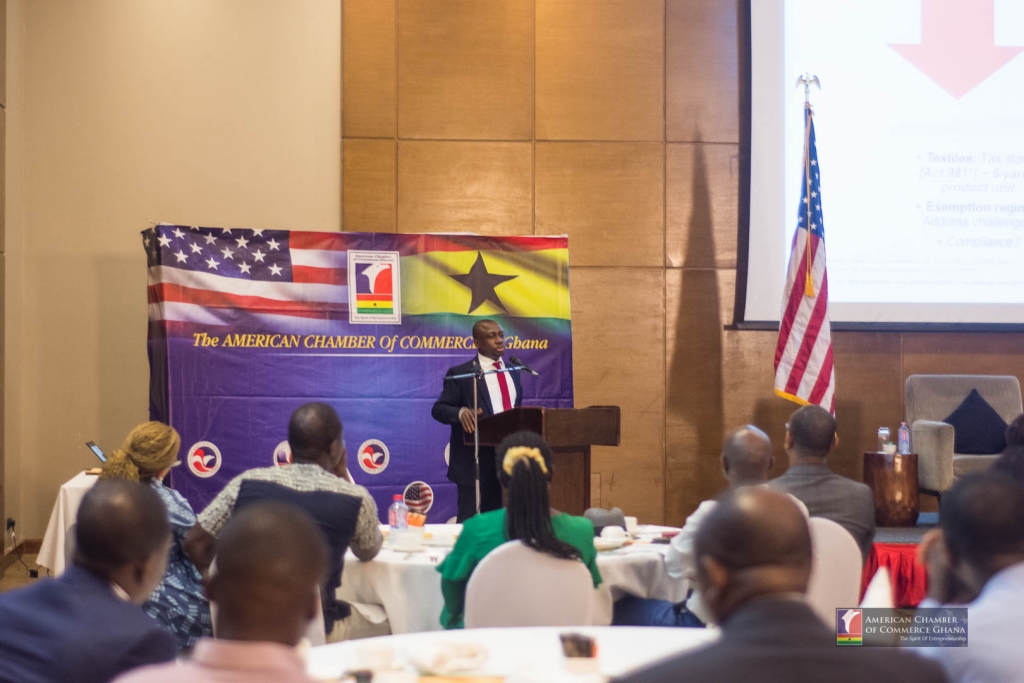
 The government has already outlined a number of tax measures under the various tax components. Under income and property tax, the government intends to increase the top marginal band to 30%, convert the mining sector exemption into equity, increase tax free band (tax wage earners that earn above the minimum wage), shift withholding tax in small scale mining from its current point to export, grant tax holidays to businesses under the One District One Factory (1D1F) initiative and effectuate housing tax concessions.