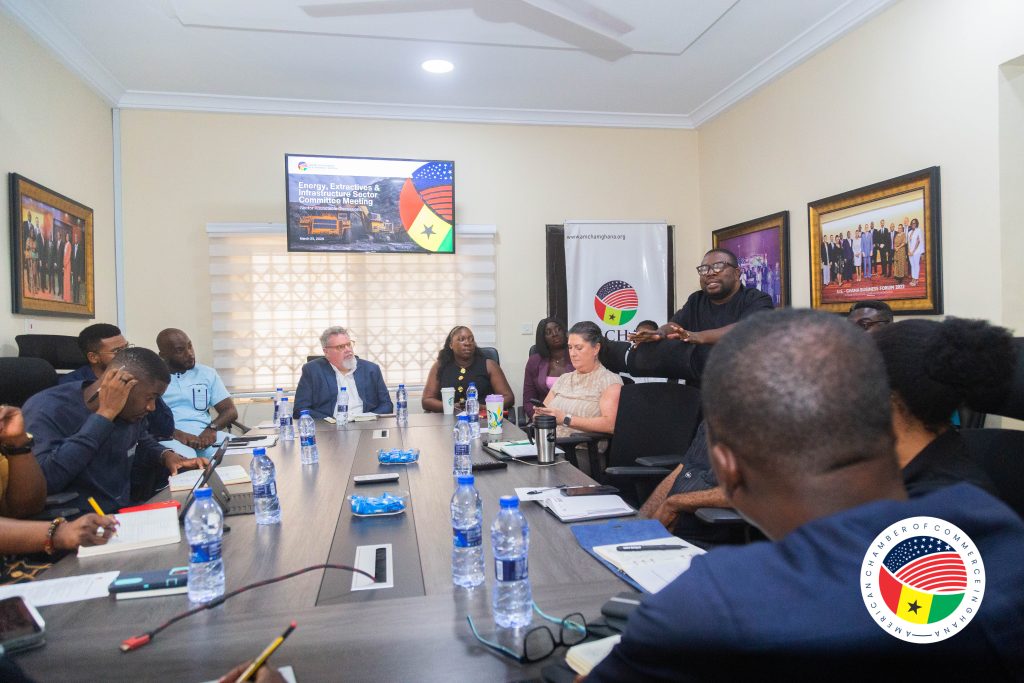

AmCham Ghana’s Energy Extractive & Infrastructure Sector Committee held its inaugural 2026 meeting this week, bringing together leaders from U.S. companies operating across Ghana’s mining, oil and gas, power generation, and infrastructure sectors to identify critical policy challenges and establish a coordinated advocacy framework for the year ahead. The session convened representatives from major U.S. companies, including Halliburton, Schlumberger, Newmont Ghana, General Electric, Cummins, Caterpillar, and other key players in Ghana’s extractive and energy sectors. The discussion focused on regulatory uncertainty, fiscal policy changes, and the importance of maintaining Ghana’s competitive position as West Africa’s premier investment destination in an increasingly competitive regional landscape.
Committee members from the mining sector raised pressing concerns affecting long-term investment decisions and operational sustainability. The reduction of mining lease durations from 30 years to 15 years emerged as a critical issue, with members noting that this change could fundamentally undermine the economics of capital-intensive mining projects that require decades to achieve return on investment. The multi-billion–dollar investments required for modern mining operations, from exploration through production, demand certainty over extended timeframes to justify capital deployment. Additionally, the shift from encouraging local participation to mandating local ownership raises anxieties about investment certainty for large-scale operations operators. Members emphasized that while capacity building and local participation remain important goals, ownership transfers risk discouraging new foreign direct investment at a time when Ghana needs to maintain its competitive edge in attracting mining capital.
The oil and gas sector representatives highlighted a different but equally concerning set of challenges affecting upstream investment. Members noted that Ghana has experienced minimal new exploration investment over the past five years, a troubling trend for a sector that requires continuous capital inflows to maintain production levels. Ongoing fiscal regime reviews, the introduction of a 1% local content levy on capital expenditure, and Bank of Ghana foreign exchange restrictions are creating compounding uncertainty at precisely the moment when the sector needs stability to attract new capital for both offshore and emerging onshore opportunities. Power sector representatives, meanwhile, emphasized the critical importance of maintaining the cash waterfall payment discipline recently implemented,following years of payment challenges that created arrears exceeding $2 billion. Without sustained commitment to this reformed payment structure, the sector risks returning to crisis conditions that undermine investment in generation capacity and grid infrastructure. For the Power industry, discussions centered around distribution losses of 20-30% across the power system, which drive up electricity costs and make Ghana less competitive than our neighbours for industrial operations that require reliable, affordable power.
Beyond these sector-specific challenges, committee members identified cross-cutting issues affecting the entire business environment. A recurring theme throughout the discussion was the challenge of inadequate private sector consultation before policies advance to Parliament, with members noting that by the time legislation is passed, opportunities for meaningful engagement and input have often closed, requiring expensive and time-consuming retroactive advocacy efforts.
Engagements with the Ghana Revenue Authority also featured prominently, with members highlighting opportunities to strengthen alignment around tax assessment processes furtherand enhance predictability for businesses. There was a shared recognition of the importance of fostering a more collaborative and solutions-oriented relationship with one of the government’s key revenue institutions.
The Committee therefore agreed to prioritize the establishment of regular dialogue mechanisms with GRA leadership, with an initial engagement scheduled for April 2026, as a constructive step toward deepening mutual understanding and developing more efficient pathways for addressing tax-related matters.
In response to these challenges, the Committee agreed on a multi-track advocacy approach combining direct government engagement, close coordination with the U.S. Embassy Foreign Commercial Service, and strategic communication to amplify the economic contributions of U.S. companies operating in Ghana. Members committed to providing comprehensive data on taxes paid, employment numbers, and corporate social responsibility contributions to strengthen data-driven advocacy efforts that demonstrate the tangible benefits these companies bring to Ghana’s economy. Key engagement priorities include scheduled meetings with the Ghana Investment Promotion Centre, the Petroleum Commission, the Minerals Commission, and the Ministry of Energy, while the Committee will also monitor the BRIG portal for draft policies affecting member operations and coordinate rapid responses when time-sensitive issues emerge. Representatives from the U.S. Embassy Foreign Commercial Service participated in the meeting and emphasized the importance of keeping Embassy teams informed of emerging policy issues in real-time, committing to incorporate Committee priorities into diplomatic engagement talking points and leverage high-profile opportunities such as U.S. Chamber of Commerce visits and bilateral commercial dialogues to amplify advocacy messages.
The Committee elected John Swatson from Baker Hughes as Chair and Eric Mabenge from Sewia Mining as a Vice Chair representing the infrastructure sector to ensure balanced leadership across the committee’s diverse membership. Quarterly meetings have been scheduled, with the next session set for May 19, 2026, and a WhatsApp group has been established to enable rapid information sharing between formal meetings. As one of AmCham Ghana’s most active sector committees, the Energy, Extractive & Infrastructure Sector Committee represents companies that collectively contribute billions of cedis annually in taxes, royalties, and levies while employing thousands of Ghanaian nationals across technical and leadership positions. The Committee’s advocacy work aims to ensure policies support continued U.S. investment while strengthening Ghana’s position as West Africa’s most attractive destination for extractive and energy sector investment, recognizing that regulatory certainty and collaborative public-private dialogue remain essential foundations for sustained economic growth and development.
 By By Albert Ludwig Botchway, AmCham Communications